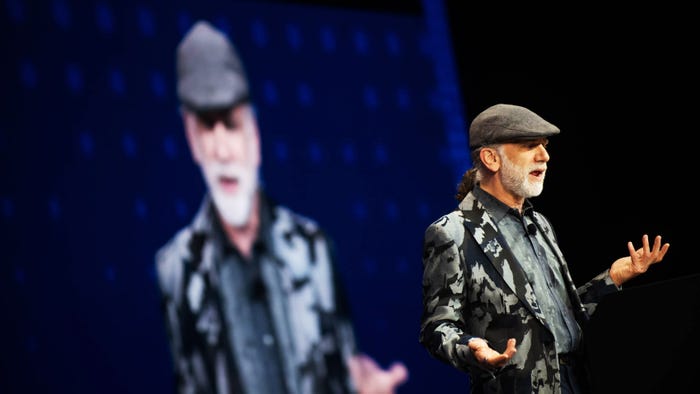
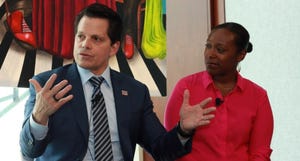
It was also intriguing to hear you describe your views on competition, whether in the business or in world-class sailboat racing: "Life is a series of acts of discovery. We're all interested in our limits, and what we can accomplish in life, and in discovering our own limits." Your comments gave people a better sense of why you've chosen via the Sun acquisition to pursue a path that most others would never have even seen, let alone taken.
It just seemed a bit odd—actually, maybe more than a bit—to see these sweeping and penetrating and candid comments from one of the world's top executives with so little mention of the role that customers are playing in your thinking. At a time when every business in every industry is going to extreme lengths to engage customers more directly and more intimately because customers today have more choices and more information and more-unique requirements, it would have been particularly valuable for you to talk less about Netezza and Teradata and IBM and SAP and Dell and HP and more about the customers that have invested tens of millions of dollars—in some cases, many tens of millions—with Oracle, and why they've done that, and how they have grown and prospered with Oracle as a strategic partner.
For example: you spoke at length about how your company has beaten IBM at software (a contention, by the way, that is not universally shared among some objective sources such as Gartner), and how you yearn to compete against it on a level playing field so that you can prove that you can beat it at hardware, but you said next to nothing about specifically how and why this will bring greater value to Oracle customers. In fact, you went out of your way to highlight at one point that IBM installs more Oracle software than any other company—if IBM's such an obviously inferior competitor, why do they sit at the top of the stack for installing your products?
That almost makes it sound like you believe the competition is all about technological features instead of about customer value, or that your interest in competition ends when the customer takes delivery of the product. Indeed, a bit later in your talk, you again cited IBM Global Services —the company that installs more Oracle software than does any other company in the world—and you criticized its approach as being driven by consultant services instead of by engineering. To me, that raises two vital questions:
1) If customers have been suffering for so long under this inferior model, why didn't you buy a company with extensive hardware assets two or three or four years ago?
2) If IBM Global Services's approach, based on consultant services, is flawed, then how has it become the #1 integrator of Oracle products in the world? And if it was an approach of which you didn't approve, why haven't you and Oracle found a different type of partner whose approach more closely resembles the engineering-level approach you intend to take with Sun?
I'm sure you have great answers for those questions but in the absence of any customer context, it's hard to know what those answers might be. In fact, the one point in the first part of your talk where customers did come up was in relation to IBM's assertion that it has taken 250 customers from Sun. Here's what you said about that:
Page 2:
Your Uncertainty Vs. CIOs' Uncertainty
![]()
1
|
2
|
3
Next Page »
Open Government: A San Francisco Treat
San Francisco took Obama's pledge of open and transparent government seriously, and launched datasf.org -- its attempt to give the city's data back to its citizens. Developers and users have embraced it, and the city's mayor is already looking ahead....

NOTE: Offer valid for U.S., U.S. possessions, & Canada only.