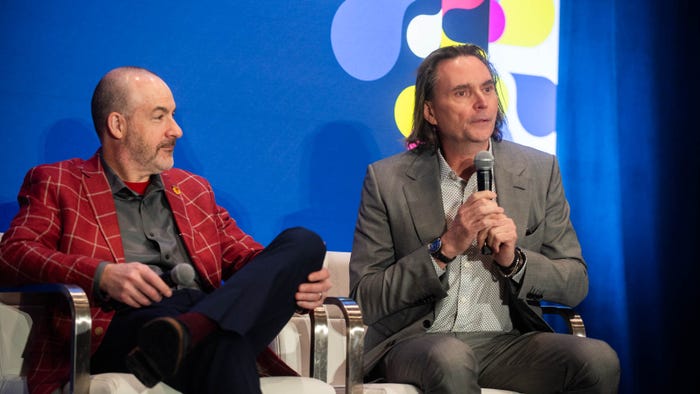
"The real value we need to provide is more scalability and performance. Sun has a lot of expertise in scalability," he said in an interview following his keynote before the MySQL Conference & Expo, an annual MySQL user group meeting, in Santa Clara, Calif. Tuesday.
MySQL is unusual among popular relational systems in being able to plug in different data store engines for different purposes. MySQL users typically use InnoDB, licensed from Oracle, when they want to do transaction processing, and Infobright's Brighthouse when they want to use a column-oriented approach for data warehousing and business intelligence. Several other options are available as well.
Mickos, former CEO of MySQL AB, recently acquired by Sun, said some of his former firm's expertise will rub off on Sun. He allowed that both firms have experience in building active communities, but MySQL is good "at selling small things, and a lot of them. We know how to find small customers and sell them something without incurring much sales cost," he said.
The open source database continues to be downloaded over 50,000 times per day. MySQL products marketing manager Zack Urlocker says the number has increased to over 60,000 since Sun took over MySQL AB. The MySQL organization, now part of Sun's database group, sells technical support for free downloads of the system or commercial licenses for parties building products that include MySQL. Its revenue was well below $100 million when Sun acquired the firm for $1 billion.
The next release of MySQL, release 5.1, will become available in June, two months later than planned, in order to clean up more bugs, Mickos said during his keynote address. It sounded less like a lesson learned from Sun than a lesson learned from hard experience. "Version 5.0, when it came out two years ago, didn't meet our quality standards." Community members and MySQL developers identified and cleaned up 997 bugs in the system in 2007 and have straightened out an additional 380 so far this year, he said.
With 5.1, "we are being much more conservative, much harder on ourselves," he added.
When last November Sun Microsystems' executive VP for software, Rich Green, CEO Jonathan Schwartz, and Mickos as CEO of MySQL sat down to dinner together, they discovered a great "affinity of culture and vision," said Mickos in his keynote talk. Both organizations allowed many of their employees to work from home, were discussive, debate-oriented cultures, and were seeking to lead the next wave of Internet computing by disrupting established players.
"We've really been welcomed into Sun. Maybe I'm still in the honeymoon stage but I'm loving it," Mickos told the conference attendees.
Sun CEO Jonathan Schwartz also spoke, saying open source software, such as MySQL, "is driving a huge amount of value in the world." By buying MySQL, Sun was gaining entree to thousands of new potential customers who might start out using MySQL for free, then add Sun's Glassfish open source application server or other integrated products for which they want support.
Since the acquisition, he said, he's found a new selling technique where he approaches a chief information officer and asks if he uses MySQL. The answer is frequently no. Then a Sun employee types in the company name into Mickos' tool that reports how many MySQL copies have been downloaded to that organization. It's sometimes hundreds. MySQL is already inside the organization among developers and departmental users and Schwartz makes his point that the enterprise is already relying on the database.
Stay connected and informed by visiting the CA Solutions Center Community!

Become a member today for instant access to free InformationWeek research, expert advice, peer perspectives, and more on the following topics:
- Application Performance Management (APM)
- Security Management
- Mainframe 2.0
- IT Automation
- Service Assurance
Also, visit our Government and Financial Services groups to see how these technologies apply specifically to those industries.
NOTE: Offer valid for U.S., U.S. possessions, & Canada only.