If it seems as if Flextronics CIO David Smoley is going out on a limb by licensing SaaS rather than on-premises software, he's not alone. Coca-Cola Enterprises CIO Esat Sezer recently signed up for 35,000 seats of Microsoft-hosted Exchange and SharePoint, and that number could double. Salesforce.com, which blazed the SaaS trail with a few hundred marketing execs here and a few thousand sales pros there, has a growing list of mega-accounts, too, including Japan Post with 40,000 users and Citibank with 30,000.
The numbers are impressive, but keep them in context. A self-service HR application like the one Flextronics will use doesn't have the same level of complexity as, say, SAP's manufacturing suite. That said, SaaS adoption is ramping up, and the appeal is obvious: By plugging into the applications "cloud," IT departments are freed up to work on more strategic projects. Human capital management, or HCM, "isn't considered an area of innovation and growth for companies," says Manjit Singh, CIO of Chiquita Brands, which, with 26,000 employees, represents Workday's second-largest customer. "Besides the need for simplicity, there's also the question of where companies want to invest time and resources."

At a scale of hundreds of thousands of users, SaaS isn't a no-brainer. Workday and other newcomers still must prove they can support workloads an order of magnitude greater than before. Just seven months ago, Workday CEO Dave Duffield and president Aneel Bhusri said the vendor had work to do to scale its architecture for companies with tens of thousands of employees. They now say they've made it over that hump.
And CIOs need to check their assumptions about how much they stand to save. Microsoft senior VP Chris Capossela calls expectations of automatic cost savings from SaaS "overblown." Because SaaS is offered as a subscription, he says, "you're going to pay forever." In March, Microsoft revealed deals to provide "single-tenant" SaaS to a half-dozen large companies, including Blockbuster and Ingersoll Rand. Microsoft's multitenant SaaS is in beta testing now.
Flextronics CIO Smoley is counting on Workday to support employees in 30 countries, taking into account idiosyncrasies from Chinese law to German labor unions. Flextronics will share Workday apps with other companies, all relying on Workday to provide software that's fundamentally the same for everyone yet unique where necessary. Looking to replace some 80 disparate HR systems, Smoley compared Workday feature by feature with "all the traditional" providers of HR software, including Oracle and SAP.
![]()
![]()

![]()
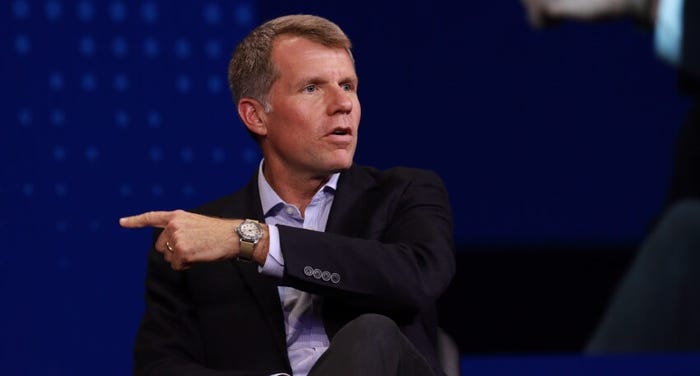
Flextronics' Smoley is looking to replace 80 HR systems![]()
Photo by Michael Bonadio![]()
Page 2:
Redirecting Resources
![]()
1
|
2
Next Page »
Stay connected and informed by visiting our Enterprise IT Community!

Become a member today for instant access to free InformationWeek research, expert advice, peer perspectives, and more on the following topics:
- Application Performance Management (APM)
- Security Management
- Mainframe 2.0
- IT Automation
- Service Assurance
Also, visit our Government, Retail and Financial Services groups to see how these technologies apply specifically to those industries.
NOTE: Offer valid for U.S., U.S. possessions, & Canada only.