Google CEO Imagines Era Of Mobile Supercomputers
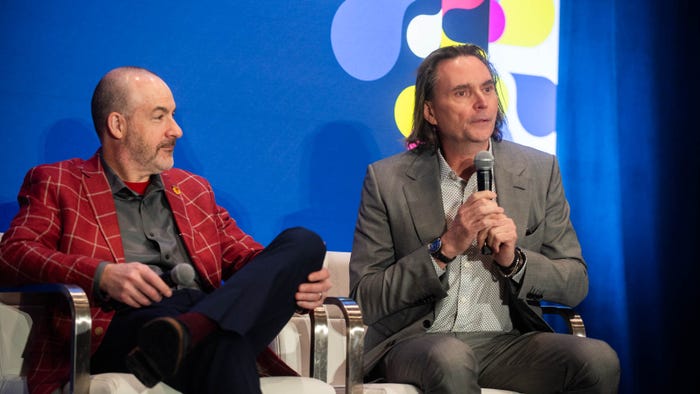
The future, as Eric Schmidt describes it, belongs to smart phones and data centers.Before some 900 technology executives at the Utah Technology Council's Hall of Fame event in Salt Lake City on Friday, Google CEO Eric Schmidt described the future sought by Google and other tech companies: 100-megabit broadband and a supercomputer in every pocket.
"A billion people on the planet are carrying supercomputers in their hands," Schmidt said in a conversation with Fusion-io CEO David Bradford. "Now you think of them as mobile phones, but that's not what they really are. They're video cameras. They're GPS devices. They're powerful computers. They have powerful screens. They can do many many different things, and oh, by the way, you can talk on them too. That's what the mobile phone of today is."
More Software Insights
Webcasts
- Insurance Workforce Optimization: How To Work Smarter To Benefit Your Customers, Employees and the Bottom Line
- Creating Business Agility with Highly Integrated Core Systems
White Papers
More >>Reports
More >>And in the next few years, he said, you'll see things you can't even imagine now.
As examples of what's being done with Android mobile phones, Schmidt cited an application that can take pictures of barcodes, identify the corresponding product, and compare prices online. He also mentioned an application that can take a picture of a menu in a foreign language and translate it.
"The creepiest one of all, take a picture of person -- somebody built a demonstration -- and we can tell you who that person is," he said, adding, "By the way, that's obviously useful if you're a policeman."
The back-end of these yet-to-be imagined services is cloud computing. "It's a bigger phenomena than, for example, the PC industry, and probably the next big wave of computing," Schmidt said, a point he made more emphatically at a press conference with Utah's two Senators, Orin Hatch and Bob Bennett.
"Even the most brutal incumbent, if I can use that as a description of Microsoft, is moving in that direction," he said.
And the future that Schmidt envisions is bringing major changes to our society, through social computing.
"We're going from a model where the information we had was pretty highly controlled by centralized media operatives to a world where most of our information will come from our friends, from our peers, from user-generated content," he said. "These changes are profound in the society of America, in the social life and all the ways we live."
Related Reading
| To upload an avatar photo, first complete your Disqus profile. | View the list of supported HTML tags you can use to style comments. | Please read our commenting policy. |
Subscribe to RSSResource Links
Related Webcasts
- Best Practices for Improving Database Testing: Upgrades, migrations, business growth and more - ensuring you can handle the workload!
- Insurance Workforce Optimization: How To Work Smarter To Benefit Your Customers, Employees and the Bottom Line
- Creating Business Agility with Highly Integrated Core Systems
- Future Proofing your Video Communication Strategy
- SMB Server Guide: Meeting Email, Virtualization, and Business Application Challenges
This Week's Issue
Free Print Subscription
SubscribeCurrent Healthcare Issue
- InformationWeek Healthcare CIO 25: Our second annual honor roll of the health IT leaders driving healthcare's transformation.
- EHR Unreadiness: Only a small percentage of physicians planning to apply for Meaningful Use funds have e-health record systems capable of achieving most of the requirements. .
- And much more!
- Read the Current Issue
Related Whitepapers
- Readying your portals for social business
- RHEV for Servers Feature Comparison
- Is your database ready for your companys future?
- Batch processing with WebSphere Compute Grid: Delivering business value to the enterprise. Reduce or eliminate batch windows by running batch and OLTP 24X7 and achieve higher throughput
- Smarter Commerce for Consumer Electronics White Paper
Featured Broadcast
Organizations must rigorously protect their data from all threats - including theft by outsiders and insiders, malicious attacks that can distort or destroy data, and inadvertent corruption or misuse by employees.Download this white paper and find out how to safeguard data and fulfill compliance mandates.
Learn More